
Nun ist es also endlich soweit. Nach ausgiebiger Testfahrt und Abschluss aller Vorbereitungen machen wir nach 5 Monaten die Leinen in Arrecife los und setzen Segel Ri Gran Canaria. Dazu haben wir uns den Vorhafen von Arrecife ausgesucht, sehr zum Leidwesen eines Containerschiffs, dass natürlich genau jetzt aus dem Hafen ausfahren will. Die Besatzung des Lotsenboots sind nicht „amused“, obwohl wir ausweichen, also nichts wie rauf mit dem Segel und weg. Leider ist der Wind anfangs sehr übersichtlich, so dass wir den Motor unterstützend dazu nehmen. Ausserdem verabschiedet sich die Bremse vom Niederholer am Großbaum, so dass ein optimaler Segeltrimm schwierig ist. Wir versuchen unser Bestes mit Besan, Groß und Genua, schlussendlich nehmen wir aber das Groß weg und segeln nur mit Besan und Genua. Leider rutscht uns dann zu allem Überfluss auch noch der Rutscher vom Unterlieg am Besan aus den Führung am Baum, so dass wir den Baum nur noch bedingt weit rauslassen können. Alles nicht so optimal. 🥴 Also gibt es erstmal Nudelsalat zum Abendessen und der Wind ist dann auch noch gegen uns. In der Nacht, wir können inzwischen wieder Segeln, ist da plötzlich so ein seltsames quietschendes Geräusch aus dem Motorraum. Bei näherem Hinsehen stellt sich heraus, dass eine Seite der Antriebswellenkupplung abgebrochen ist. Nun hat die Welle Spiel und vibriert, ausserdem dreht sie beim Segeln nicht mehr mit. Machen können wir da jetzt nichts. Zum Glück bleibt der Wind, so dass wir den Motor nicht brauchen bis wir kurz vor der Marina in Las Palmas sind. Bei der Einfahrt unter Motor hört man dann aber ganz deutlich dass die Welle Geräusche macht und wir hoffen, dass wir möglichst schnell anlegen können. Das Manöver, längsseits am Check In Steg gestaltet sich schwierig. Die Anfahrt gegen den Wind misslingt beim ersten Versuch und wir fahren uns seitlich einen langen tiefen Kratzer ein, an freiliegenden Schrauben die nicht von unseren Fendern abgedeckt wurden 😭. Beim zweiten Versuch haben sich inzwischen einige Helfer am Steg eingefunden, die uns tatkräftig unterstützen. Wir sind durch und die Stimmung am Gefrierpunkt. Bei der Anmeldung im Marina Office klärt Franz ab, dass wir zumindest noch eine Nacht an diesem Steg liegen bleiben dürfen, damit wir die Erstversorgung des Kratzers machen können. Sehr sehr ärgerlich.
Am nächsten Tag Nachmittags müssen wir dann den Welcome Steg räumen und werden auf unseren finalen Liegeplatz gebracht. Hier funktioniert das Anlegen gut bis auf den üblichen Dreck von den Mooring Leinen. Unseren Kratzer haben wir bereits einige Male lackiert und mit Hilfe des Beiboots können wir die Arbeiten noch Abschließen.
Wie an jedem neuen Standort, grüßt auch hier täglich das Murmeltier 😉. Wo bekomme ich Ersatzteile, wer kann die Wellen Kupplung reparieren, wo können wir waschen, wo ist der nächste Supermarkt. Der große Vorteil der Marina in Las Palmas ist die ARC (Atlantic Rallye for Cruisers oder wie böse Zungen behaupten „Betreutes Segeln“) die jedes Jahr mit c.a. 300 Booten im Herbst hier einfällt und die Atlantik Überquerung ihrer Klienten vorbereitet. Daher sind alle Gewerke und Nautik Shops deutlich besser ausgestattet als in Lanzarote. Über Janis und Cindy mit ihrer „Heima“ haben wir eine Empfehlung für Miguel bekommen um die Wellenkupplung zu schweißen. Es ist erfrischend, zur Abwechslung mal Mechaniker zu haben die pünktlich, verbindlich und kompetent sind. Die Wellenkupplung ist schnell repariert und wieder eingebaut und nach ein paar kleinen Unsicherheiten in Punkto richtige Lage der Welle funktioniert alles wieder. Auch das temporäre Tropfen der Stopfbuchse lässt sich lösen und wir finden Zeit uns ein wenig die Insel anzuschauen. Las Palmas hat eine sehr schöne historische Altstadt und die Wanderung zum Pico de las Nieves ist einfach grossartig. Ausserdem hat diese Insel etwas, was wir auf Lanzarote schmerzlich vermisst haben: Es ist grün. Soooo schön. Letztendlich sind wir dann doch fast 3 Wochen hier, haben wieder interessante Menschen kennen gelernt und eine gute Zeit.
Da man ja bekanntlich aufhören soll wenn es am schönsten ist, checken wir schon seit ein paar Tagen passende Wetterfenster für unsere Überfahrt auf die Kap Verden. Unser Sprung raus aus Europa und der bisher längste Schlag. Spannend. Wie wird es uns gehen, wie kommen wir klar?
Die Windvorhersage prognostiziert die ersten Tage stabilen Passatwind und wir beschließen, unsere Genua gegen die Passatsegel zu tauschen. Es dauert eine ganze Weile bis die Segel aufgezogen sind und sich auch ein und ausrollen lassen. Try und Error. Für uns ja auch das erste Mal. Daher ist es gut, dass wir es am Liegeplatz gemacht haben und nicht unterwegs. Da die Passatsegel ja ausgebaumt gefahren werden, lassen wir zur Überprüfung die beiden Spibäume herunter und das ist auch gut so. Gleich beim ersten Baum ist das Mastfitting gebrochen. Ich möchte mir nicht vorstellen dass uns das draussen passiert. Zu unserer großen Überraschung hat der Segelmacher Alisios das Teil da und wir können den Baum relativ schnell reparieren. Leider gibt es keinen Ersatz für den anderen Baum. Daher lackieren wir das Teil neu und hoffen, dass es so recht lang hält.
Nun ist also alles vorbereitet und am 28.07.2025 um 10.30 lösen wir die Leinen in Las Palmas und machen uns, nach einem kurzen Tankstopp, auf den Weg nach Mindelo. Natürlich will Franz das Setzen der Segel inklusive Bäume wieder im Vorhafen machen, was aber so nicht funktioniert. Ausserhalb in Küstennähe geht es dann besser, ist aber insgesamt sehr stressig und als die Bäume endlich da sind wo sie hin sollen, stellt sich heraus, dass die Schoten an den Segeln falsch angebracht sind und sich nicht ausrollen lassen. Was also tun. Vom Deck aus ist das nicht zu machen da zu hoch am Vortstag, daher entscheiden wir, in den Süden der Insel zu motoren um ruhigere Bedingungen zu haben. Dort können wir das Problem beheben und endlich die Passatsegel setzen. Leider habe ich nicht mehr all zu viel davon, ich bin zu diesem Zeitpunkt schon heftig Seekrank. Damit ist der erste Tag gelaufen. Ich falle in die Koje für die nächsten 20h und Franz muss die erste Nachtschicht ganz alleine machen. Sorry. So heftig wie es mich erwischt, so schnell ist es dann auch wieder vorbei und es geht nur noch aufwärts. Wir segeln mit dem Passat und grooven uns ein. Es ist so schön. So muss Segeln sein. Wir nehmen sogar unsere Aries (Windfahnensteuerung) in Betrieb und was soll ich sagen – funktioniert. Natürlich ist in Punkto Einstellung noch ganz viel Luft nach oben, aber an Möglichkeiten zum Üben fehlt es uns ja nicht. So gehen die Tage dahin und wir nähern uns unserem Ziel immer ein bisschen mehr.
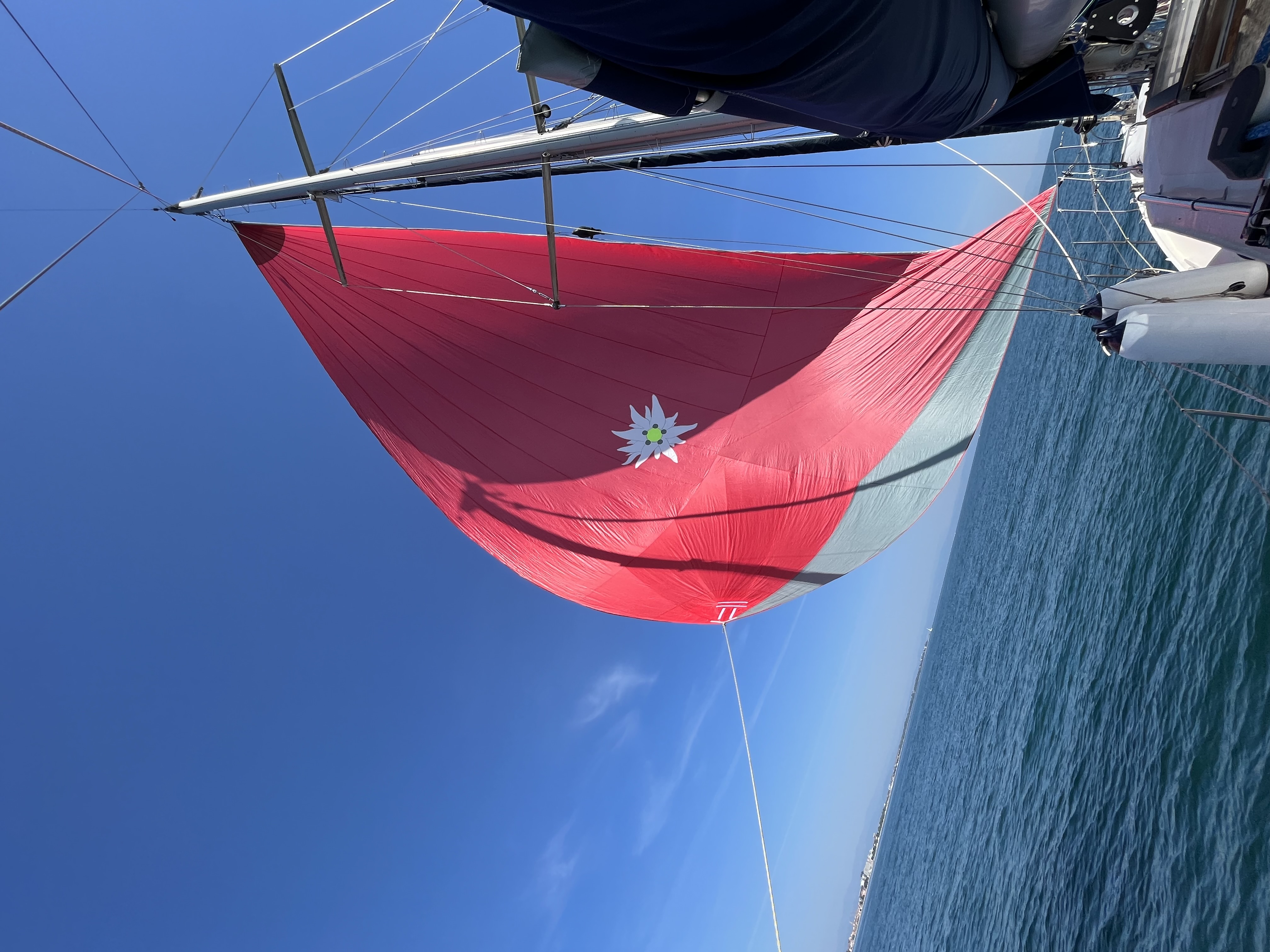
Leider verlässt uns dann, wie vorhergesagt, irgendwann der Wind und wir bergen Segel und Bäume. So richtig Lust auf Motor haben wir aber nicht und beschließen unseren Genacker auszupacken. Es bedarf einiger Vorbereitung aber dann ist es soweit und das Edelweiß steht. Schaut schon fancy aus. Leider passen die Einstellungen noch nicht optimal, aber zumindest haben wir schon mal ein Gefühl bekommen. 😀
Zum Abend hin muss dann doch der Motor ran, allerdings verabschieden sich die Motorraumlüfter und wir müssen mit offener Tür fahren. Der Salon entwickelt sich zur Sauna und wir verlegen unseren Schlafplatz ins Deckshaus. Die Nächte sind teilweise sternenklar und man sieht fluoreszierende Algen im Wasser. Die letzten beiden Tage bis Mindelo motoren wir so.
Und dann sind wir da, 1000sm, 6 Nächte, 7 Tage, wir haben es geschafft und es geht uns super. Danke Amber!
Das Anlegen ist hier auch etwas besonderes, Heck zum Pier, vorne aber keine klassische Mooring sondern Bojen. Die Marineros sind super und und helfen beim Festmachen. Überhaupt sind die Leute rundherum sehr freundlich und hilfsbereit. Bereits am Nachmittag kommt Elisabeth und holt die Wäsche ab. Das nenne ich mal Service. Und natürlich treffen wir unseren Freund Martin Daldrup „Martin_Jambo“
Willkomen in Mindelo 😀.
So, the time has finally come. After extensive test runs and completing all preparations, we cast off from Arrecife after five months and set sail for Gran Canaria. We chose the outer harbor of Arrecife for this, much to the chagrin of a container ship that, of course, wants to leave the harbor at this very moment. The crew of the pilot boat are not amused, even though we are giving way, so we hoist the sail and set off. Unfortunately, the wind is very light at first, so we use the engine for assistance. In addition, the brake on the downhaul on the main boom fails, making it difficult to trim the sails optimally. We try our best with the mizzen, mainsail, and genoa, but in the end we take down the mainsail and sail only with the mizzen and genoa. To make matters worse, the slider on the mizzen’s lower luff slips out of its guide on the boom, so we can only extend the boom to a limited extent. Not ideal. 🥴 So, we have pasta salad for dinner and the wind is against us. During the night, we are able to sail again, but suddenly there is a strange squeaking noise coming from the engine compartment. Upon closer inspection, it turns out that one side of the drive shaft coupling has broken off. Now the shaft has play and vibrates, and it no longer turns when sailing. There’s nothing we can do about it now. Fortunately, the wind remains steady, so we don’t need the engine until we are just before the marina in Las Palmas. As we enter under engine power, however, we can hear the shaft making noise very clearly and hope that we can moor as quickly as possible. The maneuver alongside the check-in jetty proves difficult. The first attempt to approach against the wind fails and we end up with a long, deep scratch on the side of the boat, caused by exposed screws that were not covered by our fenders 😭. By the second attempt, a few helpers have gathered at the jetty to give us a hand. We made it through, but the mood is at freezing point. When registering at the marina office, Franz clarifies that we can stay at this jetty for at least one more night so that we can provide initial treatment for the scratch. Very, very annoying.
The next afternoon, we have to clear the Welcome Steg and are taken to our final berth. Mooring here works well, except for the usual dirt from the mooring lines. We have already painted over our scratches several times and, with the help of the dinghy, we can finish the job.
As with any new location, the same questions arise daily. Where can I obtain replacement parts, who can repair the shaft coupling, where can we do laundry, where is the nearest supermarket? The big advantage of the marina in Las Palmas is the ARC (Atlantic Rally for Cruisers, or, as cynics claim, “assisted sailing”), which arrives here every autumn with around 300 boats and prepares its clients for the Atlantic crossing. As a result, all the trades and nautical shops are much better equipped than in Lanzarote. Janis and Cindy with their “Heima” recommended Miguel to weld the shaft coupling. It’s refreshing to have mechanics who are punctual, reliable, and competent for a change. The shaft coupling is quickly repaired and reinstalled, and after a few minor uncertainties regarding the correct position of the shaft, everything is working again. The temporary dripping of the stuffing box can also be fixed, and we find time to explore the island a little. Las Palmas has a very beautiful historic old town and the hike to Pico de las Nieves is simply magnificent. What’s more, this island has something we sorely missed on Lanzarote: it’s green. Soooo beautiful. In the end, we stay here for almost three weeks, meet interesting people again and have a good time.
As it is well known that one should quit while one is ahead, we have been checking suitable weather windows for our crossing to Cape Verde for a few days now. Our leap out of Europe and the longest leg so far. Exciting. How will we fare, how will we cope?
The wind forecast predicts stable trade winds for the first few days, so we decide to swap our genoa for the trade wind sails. It takes quite a while to hoist the sails and get them rolling in and out. Trial and error. It’s our first time doing this, so it’s good that we did it at the mooring and not out at sea. Since the trade wind sails are flown with the boom extended, we lower the two spinnaker poles to check them, which is a good thing. The mast fitting on the first pole is broken. I don’t want to imagine that happening to us out there. To our great surprise, the sailmaker Alisios has the part and we can repair the boom relatively quickly. Unfortunately, there is no replacement for the other boom. So we repaint the part and hope that it will last a long time.
So now everything is ready, and on July 28, 2025, at 10:30 a.m., we cast off from Las Palmas and, after a quick refueling stop, set off for Mindelo. Of course, Franz wants to set the sails, including the booms, in the outer harbor again, but that doesn’t work. It’s easier outside near the coast, but overall it’s very stressful, and when the booms are finally where they should be, it turns out that the sheets on the sails are attached incorrectly and cannot be rolled out. So what to do? It can’t be done from the deck because it’s too high on the foremast, so we decide to motor to the south of the island to find calmer conditions. There we can fix the problem and finally set the trade wind sails. Unfortunately, I don’t get to enjoy it much, as I’m already very seasick at this point. That’s the end of the first day. I fall into my bunk for the next 20 hours and Franz has to do the first night shift all by himself. Sorry. As bad as it hits me, it’s over just as quickly and things can only get better. We sail with the trade winds and get into the groove. It’s so beautiful. This is how sailing should be. We even put our Aries (wind vane steering) into operation and what can I say – it works. Of course, there is still a lot of room for improvement in terms of adjustment, but we have plenty of opportunities to practice. So the days go by and we get a little closer to our destination.
Unfortunately, as predicted, the wind eventually dies down and we stow away the sails and masts. We don’t really feel like using the motor, though, and decide to unpack our gennaker. It takes some preparation, but then we’re ready and the Edelweiss is up. It looks pretty fancy. Unfortunately, the settings aren’t quite right yet, but at least we’ve got a feel for it now. 😀
Towards evening, we have to start the engine after all, but the engine compartment fans stop working and we have to sail with the door open. The salon turns into a sauna and we move our sleeping quarters to the deckhouse. Some of the nights are starry and you can see fluorescent algae in the water. We motor like this for the last two days to Mindelo.
And then we’re there, 1000 nautical miles, 6 nights, 7 days, we’ve made it and we feel great. Thank you, Amber!
Mooring here is also a bit special, with the stern facing the pier, but no classic mooring at the front, just buoys. The marineros are great and help with mooring. In general, the people around here are very friendly and helpful. Elisabeth comes by in the afternoon to pick up the laundry. That’s what I call service. And of course we meet our friend Martin Daldrup “Martin_Jambo.”
Welcome to Mindelo 😀.


