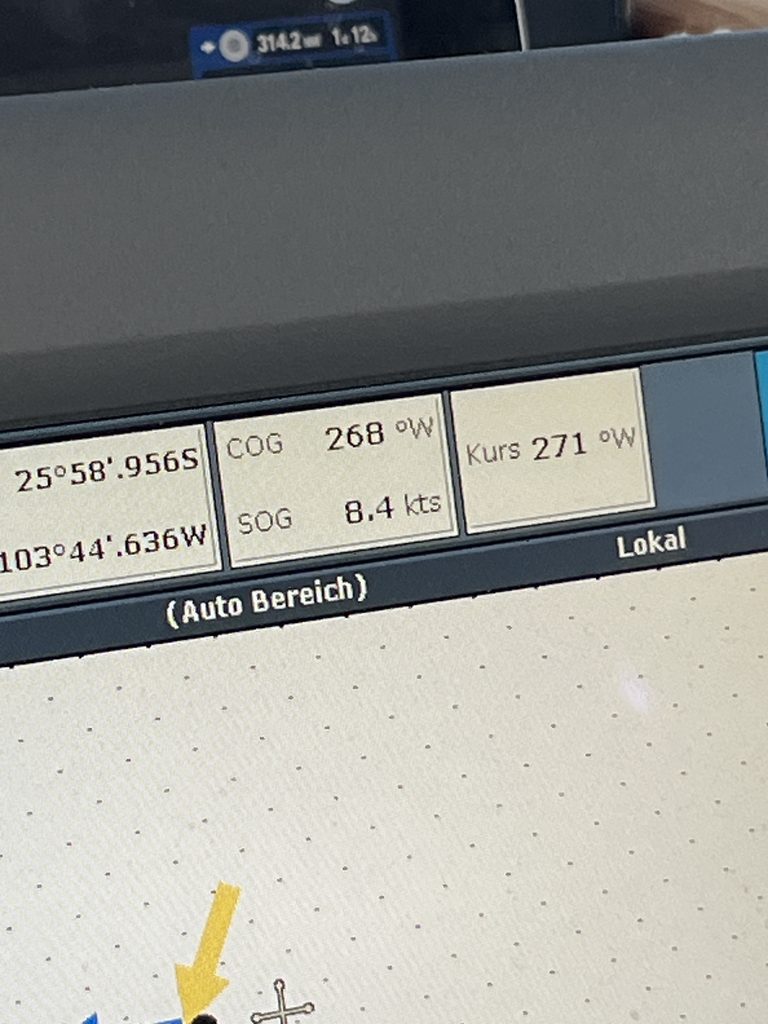
Rapa Nui…, klingt geheimnisvoll, voller Abenteuer und Geschichte. Das ist auch unser Gedanke und so brechen wir am 03.08.26 auf, zu unserem bisher längsten Schlag, von der chilenischen Küste zu den Osterinseln.Vor uns liegen rund 2500 Seemeilen weg vom Festland hinaus in die Weiten des Südpazifik. Veranschlagt sind 21-30 Tage, abhängig von Wind und Wetter und wir freuen uns darauf. Die erste Woche präsentiert sich der Ozean von seiner absoluten Schokoladenseite. Beständiger Halb-bis Raumwind mit 15-25kn und moderate Welle, dazu strahlendes Wetter, absolutes Champagnersegeln. Mit vollem Tuch ziehen wir mit 7-8.5kn dahin und wahrscheinlich könnten wir sogar noch schneller, wenn nicht unsere Welle mit zunehmender Geschwindigkeit immer mehr vibrieren und dies auch auf das Getriebe übertragen würde. So entscheidet Franz aus Sicherheitsgründen, unsere Fahrt durchs Wasser auf 7kn zu deckeln und wir verkleinern unsere Segelfläche entsprechend. Schade, ich hatte mich gerade an den „Speedmodus“ gewöhnt. So vergeht die erste Woche sehr beschaulich und uns wachsen langsam wieder „Seebeine“. So kann es weitergehen. Aber wie das so ist mit den Wünschen, zeigt uns der Südpazifik auf dem Rest der Reise ein ganz anderes Gesicht. Die verbleibenden 2 Wochen sind geprägt von unbeständigem Wind, Starkwind mit 38kn bis Flaute innerhalb von 2 Stunden, Welle mit 3-4m (vom Wellenberg ins Wellental fühlt man sich wie in der Achterbahn), Squalls (lokale Unwetter Zellen mit Regen und Starwind, vorzugsweise Nachts) und gefühlt alle 5 Minuten eine Richtungsänderung vom Wind, alles ist dabei. Die Tage und vor allem die Nächte sind geprägt von Manövern, Kursanpassungen und Segelarbeiten und das zehrt an den Kräften und zerrt an den Nerven. Das diese Passage nicht so einfach zu segeln sein wird, aufgrund der vorherrschenden Wettersysteme, war uns von vornherein klar, aber nach unserer Erfahrung in der ersten Woche haben wir wohl irgendwie gehofft es würde nicht so herausfordernd werden. Dazu kommen dann natürlich noch die diversen kleine Schäden, die es unterwegs zu reparieren gilt. So ist uns z.B. die Reffleine der Genua aus der Führung in der Furling gerutscht. Nicht so praktisch, wenn sich die 60qm bei 20kn Wind nicht mehr einrollen lassen. Da das Auseinanderbauen der Rollreffanlage auf hoher See nicht ideal ist, macht Not erfinderisch und mit ein bisschen Draht und Fingerspitzengefühl kann Franz die Leine wieder fixieren. Seitdem bedienen wir sie allerdings eher mit Vorsicht und sie ist uns inzwischen auch schon wieder rausgerutscht. Ich glaube, man ist sich der Kräfte und Belastungen die auf das Schiff und alle beteiligten Teile wirken gar nicht so bewusst. Auf längeren Passagen zeigt sich meist schnell, wie sehr das Material in Anspruch genommen wird. So hat sich ein Bolzen unseres Ankerkettenwirbels durch Vibration herausgedreht und war weg. Die Kette ist somit nicht mehr mit dem Anker verbunden. Da grundsätzlich alle Teile extra und doppelt gesichert sind, kann nicht viel passieren. trotzdem benötigen wir ein Ersatzteil, dass wir aber zum Glück an Bord haben. Ausserdem haben wir das frisch reparierte Windex verloren, mussten Scheuerstellen aus der Genuaschot schneiden, einen Relingsdraht neu fixieren und die Stopfbuchse tropft auch immer wieder mal und keiner weiss wieso.
Ein ganz besonders Highlight ist unser Versuch die Aries (Windfahnensteuerung) in Betrieb zu nehmen. Eigentlich eine geniale Erfindung für lange Passagen mit beständigem Wind, dann muss der Autopilot nicht ständig laufen. Allerdings sind wir nicht in der Lage das System so einzustellen dass es unseren Kurs hält. Die Windfahne reagiert viel zu langsam und träge. Nach stundenlangem tüfteln und Beratung durch Dr. Google kommen wir überein, dass wohl die Gelenke durch Salzwasser schwergängig sind und einer gründlichen Reinigung bedürfen. Damit wird die Aries wieder in ihren Dornröschenschlaf zurück versetzt. Hoffen wir, dass uns unser Autopilot nie im Stich lässt. Mit der Hand möchte ich bei diesen Bedingungen nur sehr ungern steuern.
Und dann ist es soweit, nach 18 Tagen und 19h sehen wir die Isla de Pascua im Morgendunst auftauchen. Was für ein Gefühl. Die Fahrt hierher hat uns einiges abverlangt, aber wir haben es geschafft.
Insgesamt 2575nm in 18 Tagen und 21h, 423h unter Segeln, 30h unter Maschine.
Leider können wir nicht direkt nach Hanga Roa sondern ankern vorläufig in der Hanga Hotuiti. Die Armada hat uns die genauen Koordinaten für unseren Platz geschickt und unser Anker hält auf den ersten Versuch. Auf Rapa Nui gibt es keine geschützten Ankerbuchten, Mooringbojen, oder eine Marina. Je nach Wind ankert man in Lee der Insel, zum Pazifik hin offen und dem Schwell ausgesetzt, was die ganze Sache sehr schaukelig macht. Bei Nordwind kann man daher vor Hanga Roa nicht liegen. Da wir hier nicht einklarieren können, dürfen wir natürlich auch nicht von Bord. Für heute ist das auch gar nicht mehr so wichtig. Nachdem wir unsere Ankunft gebührend gefeiert haben, gleichen wir erst einmal unser Schlafdefizit aus. Am nächsten Tag werfen wir dann einen genaueren Blick auf die Insel, immer noch von Bord aus, und jetzt wird uns klar, warum auch das Anlanden mit dem Beiboot schwierig bis unmöglich ist. Der Schwell der vom Pazifik kommt baut sich zu einer nicht zu unterschätzenden Brandung auf. Da bleibt nur zu hoffen, dass das in Hanga Roa einfacher geht. Franz ist im ständigen Austausch mit der Armada und vereinbart eine Verlegung des Ankerplatzes nach Hanga Roa für Dienstag den 25.08.26. Die Überfahrt unter Maschine dauert 5h und nun schaukeln wir hier am Anker. Leider ist die Brandungssituation nicht recht viel besser, trotzdem wird sich Franz morgen der Herausforderung stellen und versuchen mit dem Beiboot anzulanden. Und wenn alles gut geht, können wir hoffentlich in den kommenden Tagen etwas von der Insel sehen. So einfach ist es dann natürlich nicht. Das Klarmachen des Beiboots und fixieren des Motors gestaltet sich schwierig ob der heftigen Rollbewegung des Schiffes. Auch die Brandung wirkt nicht wirklich weniger seit gestern. Und auch von Seiten der Armada gibt es kein grünes Licht für einen Landgang. Also ein weiterer Tag an Bord. Es nervt und ist frustrierend und so gerne wir die Insel besichtigen würden so wenig haben wir Lust auf diese tagelange Warterei.
Fortsetzung folgt….
Rapa Nui… it sounds mysterious, full of adventure and history. That’s exactly how we feel, and so on August 3, 2026, we’ll set sail on our longest voyage yet—from the Chilean coast to Easter Island. Ahead of us lie about 2,500 nautical miles away from the mainland, out into the vastness of the South Pacific. We estimate it will take 21–30 days, depending on wind and weather, and we’re looking forward to it. During the first week, the ocean shows itself from its very best side. Steady half-to-broad reach winds of 15–25 knots and moderate swells, plus glorious weather—absolute champagne sailing. Under full sail, we’re cruising along at 7–8.5 knots, and we could probably go even faster if it weren’t for the fact that our hull vibrates more and more as our speed increases, which would also be transmitted to the drive train. So, for safety reasons, Franz decides to cap our speed at 7 knots, and we reduce our sail area accordingly. Too bad—I’d just gotten used to “speed mode.” So the first week passes very peacefully, and we’re slowly getting our “sea legs” back. Let’s hope it stays this way. But as is often the case with wishes, the South Pacific shows us a very different side for the rest of the trip. The remaining two weeks are marked by unpredictable winds—ranging from strong gusts of 38 knots to calm conditions within two hours—waves of 3–4 meters (from crest to trough, it feels like a roller coaster), squalls (localized storm cells with rain and strong winds, mostly at night), and what feels like a change in wind direction every five minutes—we’ve experienced it all. The days, and especially the nights, are filled with maneuvers, course adjustments, and sail changes, which take a toll on our strength and fray our nerves. We knew from the start that this passage wouldn’t be easy to sail due to the prevailing weather systems, but after our experience in the first week, we’d somehow hoped it wouldn’t be quite so challenging. On top of that, of course, there are the various minor damages that need to be repaired along the way. For example, the genoa’s reefing line slipped out of its guide in the Furling system. Not exactly convenient when the 60 square meters can no longer be furled in 20-knot winds. Since taking apart the furling system on the high seas isn’t ideal, necessity is the mother of invention, and with a bit of wire and a delicate touch, Franz is able to secure the line again. Since then, however, we’ve been operating it with caution, and it’s actually slipped out again in the meantime. I don’t think people are really aware of the forces and stresses acting on the boat and all its components. On longer voyages, it usually becomes clear quite quickly just how much strain the materials are under. For example, a bolt on our anchor chain swivel came loose due to vibration and fell out. As a result, the chain is no longer connected to the anchor. Since all parts are always secured extra carefully and with double safeguards, not much can go wrong. Still, we need a replacement part—which, fortunately, we have on board. We’ve also lost the freshly repaired Windex, had to cut out scuff marks from the genoa sheet, reattach a railing wire, and the stuffing box keeps dripping from time to time, and no one knows why.
A particular highlight is our attempt to get the Aries (windvane steering) up and running. It’s actually a brilliant invention for long crossings with steady winds—that way, the autopilot doesn’t have to run constantly. However, we’re unable to adjust the system so that it holds our course. The windvane reacts far too slowly and sluggishly. After hours of tinkering and consulting Dr. Google, we agree that the joints are probably seized up from salt water and need a thorough cleaning. With that, the Aries is put back into its slumber. Let’s hope our autopilot never lets us down. I’d really rather not steer manually in these conditions.
And then the moment arrives: after 18 days and 19 hours, we see Easter Island emerge through the morning mist. What a feeling. The journey here took a lot out of us, but we made it.
A total of 2,575 nm in 18 days and 21 hours, 423 hours under sail, 30 hours under engine power.
Unfortunately, we can’t go directly to Hanga Roa but have to anchor temporarily at Hanga Hotuiti. The Armada sent us the exact coordinates for our spot, and our anchor holds on the first try. On Rapa Nui, there are no sheltered anchorages, mooring buoys, or a marina. Depending on the wind, you anchor on the leeward side of the island, open to the Pacific and exposed to the swell, which makes the whole experience very rocky. With a north wind, therefore, you can’t anchor off Hanga Roa. Since we can’t clear customs here, we’re naturally not allowed to go ashore. For today, that’s not really important anymore. After celebrating our arrival in style, we’ll first catch up on some much-needed sleep. The next day, we’ll take a closer look at the island—still from aboard—and now it becomes clear to us why even landing with the dinghy is difficult, if not impossible. The swell coming in from the Pacific builds into a surf that shouldn’t be underestimated. We can only hope that it will be easier in Hanga Roa. Franz is in constant contact with the fleet and arranges to move our anchorage to Hanga Roa for Tuesday, August 25, 26. The motored crossing takes 5 hours, and now we’re bobbing here at anchor. Unfortunately, the surf conditions aren’t much better, but Franz will still take on the challenge tomorrow and try to go ashore in the dinghy. And if all goes well, hopefully we’ll be able to see a bit of the island in the coming days. Of course, it’s not that simple. Getting the dinghy ready and securing the motor is proving difficult due to the ship’s violent rolling motion. The surf hasn’t really subsided since yesterday, either. And we haven’t gotten the green light from the Armada to go ashore either. So, another day on board. It’s annoying and frustrating—as much as we’d love to explore the island, we’re really not in the mood for this days-long wait.
To be continued….